
- Home
- /
- Follicular Monitoring Scan
Follicular Scan for Pregnancy in Sector 15 Gurugram
Introduction to Follicular Monitoring Scan
Understanding when ovulation occurs can be helpful for women who are trying to conceive. A follicular monitoring scan uses ultrasound to track the growth of ovarian follicles, which contain developing eggs. It can help a clinician assess follicle development and estimate when ovulation may happen. A Follicular Scan for Pregnancy in Sector 15 Gurugram may be considered as part of fertility care when monitoring is appropriate.
At Maitrika Women Health Care Clinic, Dr. Monu Yadav can discuss your concerns and help you understand whether a fertility consultation or further assessment may be suitable. Women considering a Follicular Monitoring Scan in Gurgaon can contact the clinic to confirm appointment availability and the services offered. The timing and number of scans depend on your menstrual cycle, treatment plan and medical assessment. A follicular scan can provide useful information, but it cannot guarantee pregnancy.
What Is a Follicular Monitoring Scan?
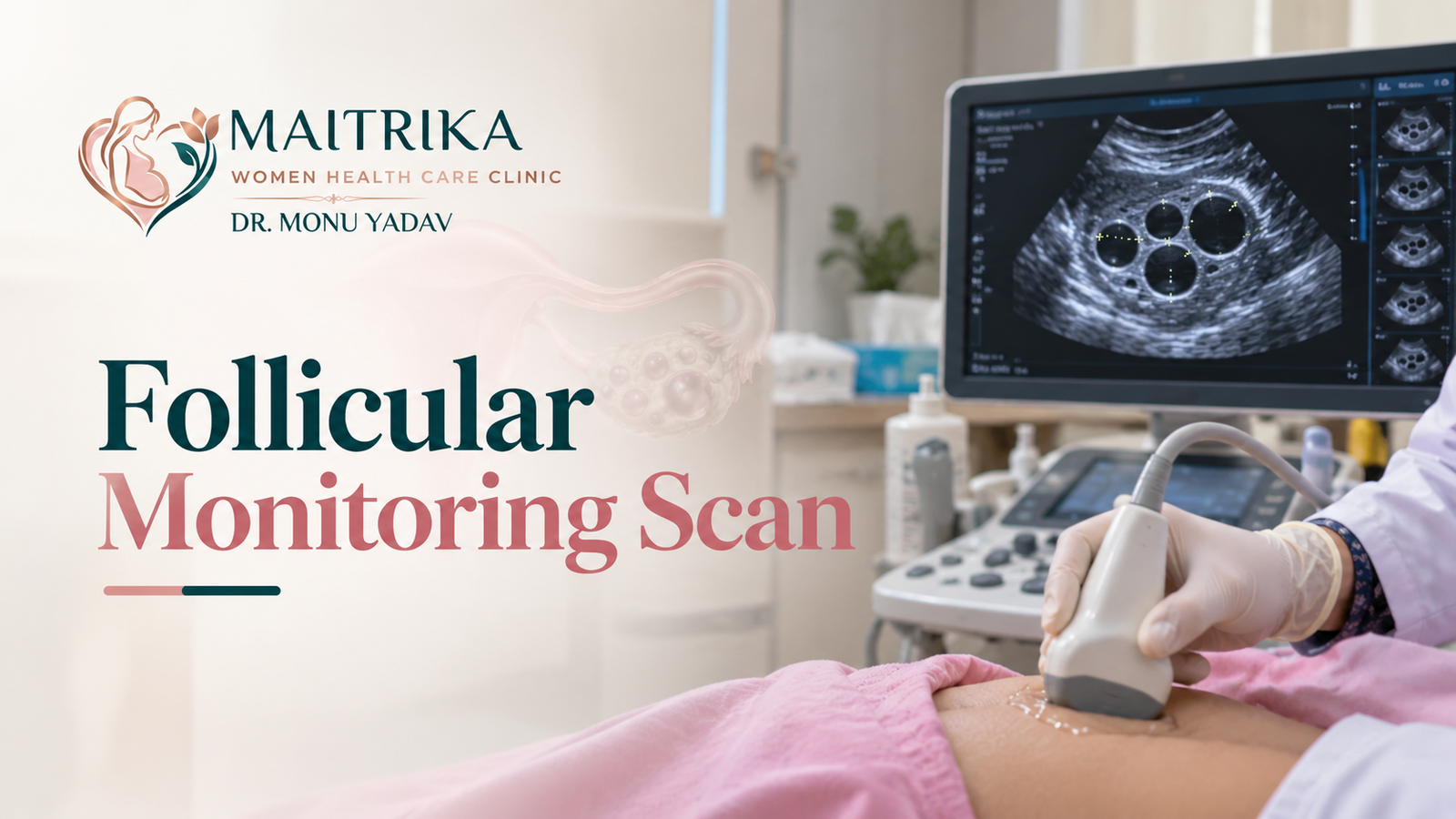
A follicular monitoring scan is an ultrasound examination used to observe the development of follicles in the ovaries during the menstrual cycle. Follicles are small, fluid-filled structures that contain developing eggs. As a follicle grows, ultrasound measurements can help the clinician assess its development.
A Follicular Study in Gurugram may involve more than one scan because follicle growth changes throughout the cycle. The results can help the clinician estimate whether ovulation may be approaching and decide whether further monitoring is needed.
The scan may also provide information about the uterus and its lining when relevant. However, it does not assess every possible cause of infertility. Other tests may be needed depending on your symptoms, medical history and fertility goals.
Why Is Follicular Monitoring Done?
Follicular monitoring helps clinicians observe changes in the ovaries during a menstrual cycle. This information may be useful when assessing ovulation or planning certain fertility treatments.
A clinician may recommend monitoring to:
Track the growth of developing ovarian follicles.
Estimate when ovulation may occur.
Assess the response to prescribed ovulation induction medicines.
Help guide the timing of intercourse or other fertility treatment steps.
Review the uterine lining when relevant to the assessment.
A Follicular Monitoring Test in Gurugram may be recommended when ultrasound findings could help guide the next step in care. The need for monitoring varies between women. Some may need repeated scans, while others may not require follicular monitoring at all.
Who May Need a Follicular Scan for Pregnancy?
A follicular scan may be useful for some women who are trying to conceive, particularly when there is a reason to monitor ovulation. However, it is not necessary for every woman planning a pregnancy.
A clinician may consider this scan if you have:
Difficulty conceiving after an appropriate period of trying.
Irregular or unpredictable menstrual cycles.
Polycystic ovary syndrome (PCOS) associated with ovulation problems.
A treatment plan involving ovulation induction medicines.
A need to assess follicle development during fertility care.
Women with regular cycles may ovulate without needing ultrasound monitoring. Similarly, a scan alone cannot determine whether the fallopian tubes are open or whether sperm-related factors may affect conception.
A Follicular Scan for Pregnancy in Sector 15 Gurugram should therefore be recommended according to your individual medical circumstances. The clinician may suggest other investigations if your history indicates that additional fertility assessment is needed.
How Does a Follicular Monitoring Scan Work?
The process is planned according to your menstrual cycle and the reason for monitoring. Your clinician will explain the steps before the examination.
1. Initial consultation
The clinician may ask about your menstrual cycle, previous pregnancies, medical conditions, current medicines and how long you have been trying to conceive. Previous ultrasound reports or fertility test results may also be reviewed.
2. Scheduling the first scan
The first scan is scheduled according to your cycle and clinical needs. There is no single scan day that is suitable for every woman because cycle length and treatment plans vary.
3. Measuring follicle development
During the scan, the clinician assesses the ovaries and measures visible developing follicles. These measurements provide information about follicle growth at that point in the cycle.
4. Repeat scans when needed
One scan may not provide enough information about how a follicle is developing. The clinician may recommend further scans to compare changes over time and assess whether ovulation may be approaching.
A Follicular Monitoring Scan in Gurgaon should follow the schedule advised by your treating clinician. Do not change medication or arrange treatment timing based only on an ultrasound measurement without medical guidance.
What Can a Follicular Study Tell You?
Follicular monitoring can provide useful information about ovarian activity during the menstrual cycle. However, the findings must be interpreted in context.
Follicle size and development
The scan measures visible developing follicles and allows the clinician to compare their growth across appointments. These measurements can help assess how the follicles are developing during that cycle.
Possible timing of ovulation
Changes in follicle development may help estimate when ovulation is likely to occur. The timing is an estimate rather than a guarantee, so follow your clinician’s advice about the next steps.
Response to fertility medication
For women using prescribed ovulation induction medicines, ultrasound monitoring may help assess how the ovaries respond. The need for monitoring depends on the treatment plan and the potential risks associated with the medicine.
Uterine lining assessment
The scan may also provide information about the uterine lining when relevant. However, follicular monitoring does not provide a complete assessment of every factor that can affect pregnancy.
A Follicular Monitoring Test in Gurugram can support fertility care, but it cannot confirm that fertilisation will occur or predict the exact chance of pregnancy. Other medical factors may also need to be assessed.
When Should You Get a Follicular Monitoring Scan?
The timing depends on your menstrual cycle, whether you are taking fertility medicines and the reason for the examination. Women with shorter, longer or irregular cycles may need different schedules.
For some women, monitoring begins early in the menstrual cycle. Follow-up scans may then be arranged according to follicle growth and the clinician’s assessment. If you are receiving ovulation induction treatment, the scan schedule may also depend on the medicine and your response.
A Follicular Study in Gurugram should not be scheduled using a fixed day without considering individual circumstances. Ask your clinician when to attend, whether repeat scans are likely and what you should do if your period starts earlier or later than expected.
Types of Follicular Monitoring Scans
Ultrasound methods may differ depending on the clinical situation. Your clinician can explain which approach is suitable.
Transvaginal ultrasound
Transvaginal ultrasound uses a small probe placed inside the vagina to produce detailed images of the reproductive organs. It is commonly used for follicular monitoring because it can provide clear views of the ovaries and developing follicles.
Some women may experience mild discomfort during the examination. You can discuss any concerns with the healthcare professional before the procedure.
Transabdominal ultrasound
Transabdominal ultrasound is performed over the lower abdomen. It may be considered in certain circumstances, depending on the patient’s needs and the information required. The quality of the images can vary based on factors such as the position of the ovaries and other individual considerations.
The appropriate method depends on your medical circumstances and the clinician’s assessment. Ask about preparation instructions before attending your appointment.
Is a Follicular Monitoring Scan Painful?
A follicular scan is generally well tolerated. Transvaginal ultrasound may cause mild pressure or discomfort for some women, while the experience varies from person to person. If you feel anxious or have concerns about the examination, discuss them with the healthcare professional beforehand.
The clinician should explain the procedure and answer your questions. If you experience unusual pain or have concerns after the scan, seek appropriate medical advice.
Follicular Monitoring Scan in Gurgaon
Women looking for a Follicular Monitoring Scan in Gurgaon should begin by discussing their menstrual history and fertility concerns with a qualified clinician. This helps determine whether ultrasound monitoring is appropriate and when the scans may be needed.
Maitrika Women Health Care Clinic is located at Shop No. 4, Lower Ground, Pal Arcade, Main Jharsa Road, Friends Colony, HVPNL Colony, Sector 15, Gurugram, Haryana 122001. Contact the clinic to confirm appointment availability and whether follicular monitoring scans are currently offered.
Women travelling from other parts of Gurgaon or Gurugram may wish to check the route and appointment details in advance. The availability of a consultation does not automatically mean that every scan or fertility procedure is performed at the clinic.
Follicular Study in Gurugram for Ovulation Tracking
A Follicular Study in Gurugram may help assess follicle growth and estimate the likely timing of ovulation. Repeated scans can provide information about changes during the cycle, which may help the clinician plan appropriate follow-up.
For women receiving fertility treatment, the findings may be considered alongside medication use, menstrual history and other investigation results. However, the scan does not confirm that an egg will be fertilised or that pregnancy will occur.
Ask your clinician how the findings relate to your individual treatment plan and whether any further evaluation is needed.
When Should You Consult a Follicular Monitoring Doctor in Gurugram?
Consider seeking medical advice if you have irregular periods, difficulty conceiving or a treatment plan that requires ultrasound monitoring. A clinician can assess your symptoms and help determine whether a follicular scan or another investigation is appropriate.
A Follicular Scan for Pregnancy in Sector 15 Gurugram may be considered when tracking follicle development could provide useful information. Women who have been trying to conceive should also discuss whether a broader fertility assessment is needed.
In general, women younger than 35 are advised to seek an infertility evaluation after 12 months of trying without pregnancy. Women aged 35 or older are generally advised to seek evaluation after six months. Earlier advice may be appropriate if periods are irregular or a known reproductive condition is present.
Visit us on Jharsa Road, Sector 15
Maitrika Women Health Care Clinic
Shop No. 4, Lower Ground, Pal Arcade, Main Jharsa Road, Friends Colony, HVPNL Colony, Sector 15, Gurugram, Haryana 122001
- Sector 15
- Jharsa Road
- Friends Colony
- Civil Lines
- Sadar Bazaar
Please confirm consultation availability and available services before you visit.
Frequently asked questions
A follicular monitoring scan is an ultrasound examination that tracks the growth of ovarian follicles during the menstrual cycle. It helps a clinician assess follicle development and estimate when ovulation may occur. A Follicular Study in Gurugram may involve repeat scans, depending on your cycle and medical needs.
A follicular scan can help estimate the likely timing of ovulation and guide certain fertility treatment steps. A Follicular Scan for Pregnancy in Sector 15 Gurugram may be considered when monitoring follicle development could provide useful information. However, the scan cannot guarantee fertilisation or pregnancy.
The timing depends on your menstrual cycle, treatment plan and clinician's advice. Women with irregular cycles may need an individualised schedule. Before arranging a Follicular Scan for Pregnancy in Sector 15 Gurugram, ask your clinician when to attend and whether repeat scans will be needed.
No. A Follicular Monitoring Scan in Gurgaon may be recommended for women who need ovulation assessment or ultrasound monitoring during certain fertility treatments. Women who ovulate regularly may not need this investigation. Your clinician can help determine whether it is appropriate for your circumstances.
A follicular study focuses on follicle growth and changes during the menstrual cycle, often through repeat scans. A routine pelvic ultrasound may assess the uterus and ovaries for other reasons. A Follicular Study in Gurugram is specifically planned when information about follicle development and possible ovulation timing is needed.
There is no fixed number for every woman. The schedule depends on follicle growth, cycle length, fertility medicines and the clinician's assessment. A Follicular Monitoring Test in Gurugram may involve one or more scans, depending on the information needed to guide care.
A Follicular Monitoring Test in Gurugram can show the size and development of visible ovarian follicles and changes that may suggest approaching ovulation. The clinician may also review the uterine lining when relevant. The findings must be interpreted alongside your menstrual history and treatment plan.
No. A follicular scan tracks follicle development and may help estimate ovulation timing. It does not confirm pregnancy or guarantee conception. Your clinician can advise when to take an appropriate pregnancy test based on your cycle and treatment plan.
A Follicular Study in Gurugram commonly uses ultrasound, including transvaginal ultrasound when appropriate. The examination is generally well tolerated, although some women may feel mild pressure or discomfort. Discuss any concerns with the healthcare professional before the procedure.
You can contact Maitrika Women Health Care Clinic in Sector 15, Gurugram, to confirm appointment availability and whether follicular monitoring is offered. If you are considering a Follicular Monitoring Scan in Gurgaon, bring your previous reports and share your menstrual history so the clinician can advise you on suitable next steps.
Book a Consultation
Follicular monitoring can help clinicians understand follicle development and estimate ovulation timing when this information is relevant to fertility care. The right schedule depends on your menstrual cycle, medical history and treatment plan.
Contact Maitrika Women Health Care Clinic to confirm consultation availability and current services. Discuss your fertility concerns with a qualified clinician before arranging scans or changing any prescribed medication. Follicular monitoring may support treatment planning, but it cannot guarantee pregnancy.