
- Home
- /
- Uterine Cavity Evaluation
Uterine Cavity Evaluation in Sector 15 Gurugram
Introduction to Uterine Cavity Evaluation
The uterus plays an important role in pregnancy, as it is where a fertilised egg implants and develops. Sometimes, changes inside the uterus may need further investigation, particularly when a woman has difficulty conceiving, experiences abnormal bleeding or has an ultrasound finding that requires clarification. Uterine Cavity Evaluation in Sector 15 Gurugram can help assess the inner space of the uterus and identify structural changes when present.
At Maitrika Women Health Care Clinic, Dr. Monu Yadav can discuss your symptoms, medical history and previous reports to help you understand whether further assessment may be appropriate. Women considering Uterine Cavity Evaluation in Gurgaon can ask about consultation availability and the investigations offered. The right test depends on individual circumstances, and not every woman needs the same examination.
What Is Uterine Cavity Evaluation?
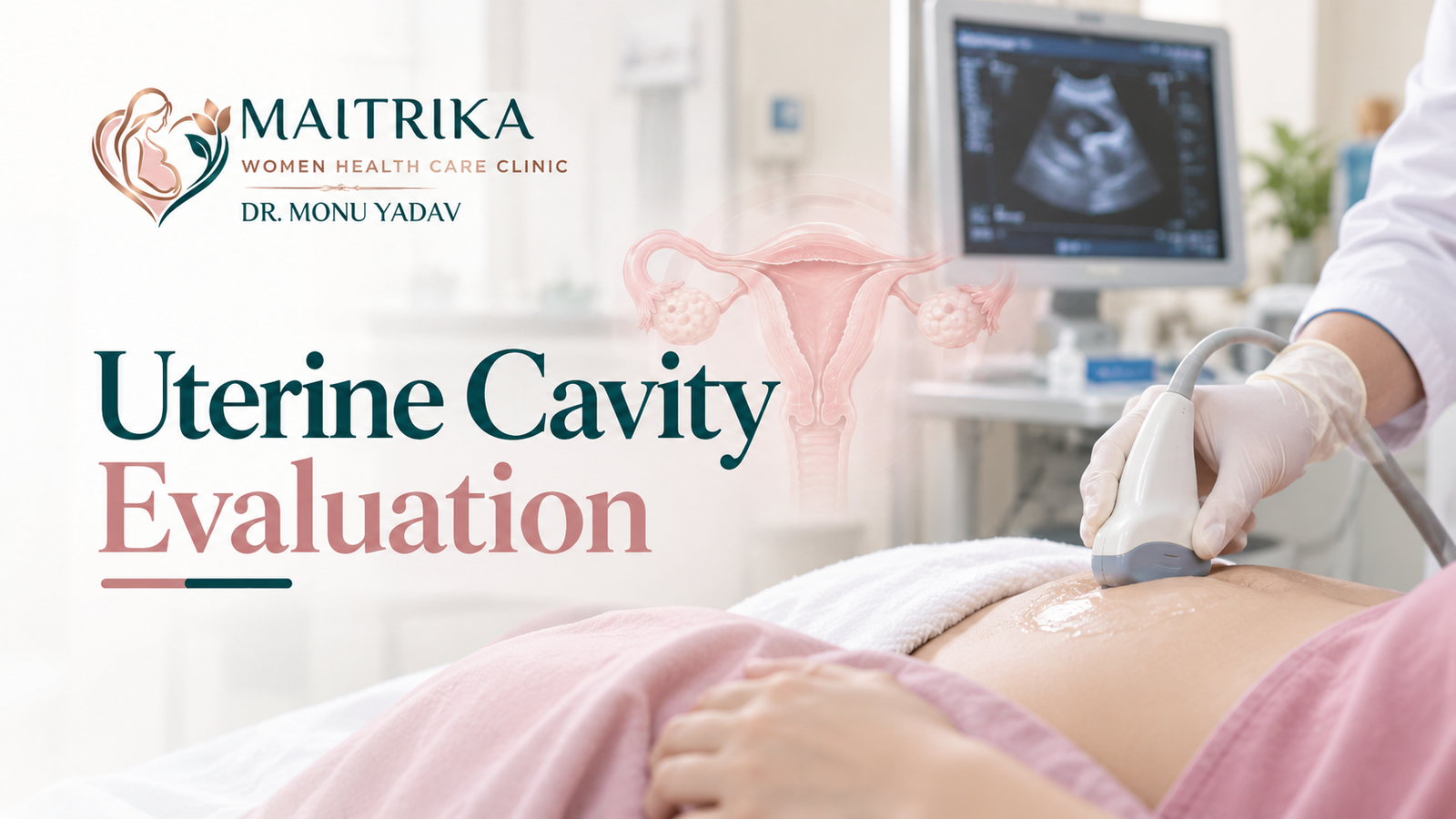
Uterine cavity evaluation is a medical assessment of the inner space of the uterus. It may help a clinician examine the uterine lining and identify certain structural changes, such as polyps, some fibroids or adhesions. The purpose is to understand whether a suspected abnormality needs further investigation or management.
A Uterine Cavity Test in Gurugram may involve an ultrasound examination or another procedure, depending on the clinical question. Some tests provide images of the uterus, while others allow a more detailed view of the cavity. These investigations are not interchangeable in every situation.
The assessment may form part of a fertility evaluation or investigation of symptoms such as unusual uterine bleeding. However, finding an abnormality does not automatically mean it is responsible for difficulty conceiving. The result must be interpreted alongside your symptoms, reproductive history and other medical findings.
Why Is Uterine Cavity Evaluation Important?
The shape and inner structure of the uterus can be relevant to reproductive health. Certain abnormalities may affect the uterine cavity, while others may have little or no effect on fertility. Appropriate evaluation helps the clinician understand whether a finding needs attention.
A clinician may consider further assessment to investigate:
Endometrial polyps: Small growths in the uterine lining that may sometimes be associated with abnormal bleeding.
Submucosal fibroids: Fibroids that extend into the uterine cavity and may affect its shape.
Intrauterine adhesions: Bands of scar tissue inside the uterus that may develop after certain procedures or uterine conditions.
Congenital uterine differences: Structural variations present from birth that may need further assessment in selected cases.
Other structural changes: Findings on an earlier scan that require clarification.
Uterine Cavity Evaluation in Sector 15 Gurugram may help clarify these findings and guide decisions about further care. However, the appropriate approach depends on the type of abnormality, its location, the symptoms involved and the woman’s reproductive goals.
When Is a Uterine Cavity Evaluation Recommended?
A clinician may recommend an evaluation when symptoms or earlier test results suggest that the uterine cavity needs closer examination. It is not necessary for every woman and should be based on individual medical circumstances.
Difficulty conceiving
If pregnancy has not occurred after an appropriate period of trying, a broader fertility evaluation may be recommended. Uterine assessment may be one part of this process, depending on the medical history and other findings.
Recurrent pregnancy loss
In selected cases, examining the uterine structure may be considered when investigating repeated pregnancy losses. The evaluation depends on the individual’s history and should be guided by a qualified clinician.
Abnormal uterine bleeding
Bleeding between periods, unusually heavy periods or other changes in bleeding patterns may require assessment. The cause can vary, so the clinician may recommend an examination or imaging based on the symptoms.
Suspected polyps or fibroids
An earlier ultrasound may show a possible polyp or fibroid. Further testing may help clarify its location, size and relationship to the uterine cavity.
Suspected adhesions or structural differences
A history of certain uterine procedures, previous pregnancy-related complications or suggestive scan findings may lead to further investigation.
Women considering Uterine Cavity Evaluation in Gurgaon should discuss their symptoms and previous reports with a clinician. The decision to investigate should be based on clinical need rather than a standard test package.
Common Tests Used for Uterine Cavity Evaluation
Different investigations provide different types of information. The clinician selects the appropriate test based on the symptoms, medical history and question that needs to be answered.
Transvaginal ultrasound
Transvaginal ultrasound uses an ultrasound probe placed inside the vagina to produce images of the uterus, uterine lining and ovaries. It can help identify some structural changes and may be used as an initial investigation.
Saline infusion sonography
Saline infusion sonography, also called saline sonohysterography, involves introducing sterile saline into the uterine cavity while ultrasound images are taken. The saline helps outline the cavity and may make some polyps or fibroids easier to identify.
Hysterosalpingography (HSG)
HSG is an imaging test that uses contrast material and X-rays to examine the uterine cavity and assess whether the fallopian tubes appear open. It may be recommended as part of a fertility evaluation when information about the tubes is also needed.
Hysteroscopy
Hysteroscopy involves passing a thin instrument with a camera through the cervix to view the inside of the uterus. It allows direct visual examination and may sometimes be used to treat certain abnormalities during the same procedure.
What Happens After Uterine Cavity Evaluation?
Women looking for Uterine Cavity Evaluation in Gurgaon should begin by discussing their symptoms, reproductive history and previous investigation results with a qualified clinician. This helps determine whether a uterine examination is appropriate and which test may provide useful information.
Maitrika Women Health Care Clinic is located at Shop No. 4, Lower Ground, Pal Arcade, Main Jharsa Road, Friends Colony, HVPNL Colony, Sector 15, Gurugram, Haryana 122001. Contact the clinic to confirm appointment availability and the services currently offered before visiting.
Women travelling from other parts of Gurgaon or Gurugram may wish to check the route and appointment details in advance. The availability of a consultation does not automatically mean that every imaging test or procedure is performed at the clinic.
Uterine Cavity Evaluation in Gurgaon
Women looking for Uterine Cavity Evaluation in Gurgaon should begin by discussing their symptoms, reproductive history and previous investigation results with a qualified clinician. This helps determine whether a uterine examination is appropriate and which test may provide useful information.
Maitrika Women Health Care Clinic is located at Shop No. 4, Lower Ground, Pal Arcade, Main Jharsa Road, Friends Colony, HVPNL Colony, Sector 15, Gurugram, Haryana 122001. Contact the clinic to confirm appointment availability and the services currently offered before visiting.
Women travelling from other parts of Gurgaon or Gurugram may wish to check the route and appointment details in advance. The availability of a consultation does not automatically mean that every imaging test or procedure is performed at the clinic.
What Conditions Can a Uterine Cavity Test Detect?
The findings depend on the investigation used. Some tests provide an overview of the uterus, while others can offer a closer look at the cavity.
A Uterine Cavity Test in Gurugram may help investigate:
Endometrial polyps: Growths arising from the uterine lining.
Submucosal fibroids: Fibroids that project into the uterine cavity.
Intrauterine adhesions: Scar tissue that may partially or completely affect the cavity.
Certain congenital abnormalities: Structural differences in the shape of the uterus.
Other cavity changes: Findings that may require further imaging or direct examination.
Not every abnormality causes symptoms or affects fertility. For example, the significance of a fibroid may depend on its size and position. A clinician should interpret the findings in the context of your medical history rather than recommending treatment based only on an imaging result.
How to Prepare for a Uterine Cavity Examination
Preparation depends on the investigation being performed. Some tests are scheduled during a particular part of the menstrual cycle, while others may have different timing requirements.
Before the appointment:
Note the dates of your recent periods and describe any unusual bleeding.
Bring previous ultrasound reports and relevant medical records.
Tell the clinician about medicines, allergies, previous procedures and any possibility of pregnancy.
Ask whether the test requires specific cycle timing or other preparation.
Follow the instructions provided for your particular investigation.
Some procedures may cause temporary discomfort or spotting. The clinician should explain what to expect and which symptoms require medical attention. Do not assume that the preparation instructions for one test apply to another.
Uterine Cavity Test in Gurugram
A Uterine Cavity Test in Gurugram may be considered when a clinician needs more information about the uterine lining or cavity. The choice between ultrasound, saline infusion sonography, HSG and hysteroscopy depends on the reason for testing and the information required.
Before proceeding, ask what the test is intended to investigate, whether it may cause discomfort, how you should prepare and when the results will be discussed. It is also reasonable to ask whether another test could provide the required information.
The right investigation is the one that addresses your clinical question safely and appropriately. Avoid booking an invasive procedure without first discussing whether it is necessary for your circumstances.
Uterine Cavity Assessment Specialist in Gurugram
A Uterine Cavity Assessment Specialist in Gurugram should consider your symptoms, previous scans, reproductive history and reason for the examination when discussing further evaluation. Sharing this information can help the clinician decide which investigation may be useful.
Women may also wish to ask how the results could affect their fertility assessment or management of abnormal bleeding. If a finding needs more specialised investigation or treatment, the clinician may recommend an appropriate referral.
The goal is to understand the findings and discuss suitable next steps. No single test can guarantee pregnancy, and the presence of an abnormality does not always mean that treatment is required.
Visit us on Jharsa Road, Sector 15
Maitrika Women Health Care Clinic
Shop No. 4, Lower Ground, Pal Arcade, Main Jharsa Road, Friends Colony, HVPNL Colony, Sector 15, Gurugram, Haryana 122001
- Sector 15
- Jharsa Road
- Friends Colony
- Civil Lines
- Sadar Bazaar
Please confirm consultation availability and available services before you visit.
Frequently asked questions
It is an examination of the inner space of the uterus to investigate possible structural changes. Depending on the clinical question, the assessment may involve ultrasound, saline infusion sonography, HSG or hysteroscopy.
It may be considered when a woman has difficulty conceiving, abnormal uterine bleeding, recurrent pregnancy loss in selected circumstances or an earlier scan showing a possible abnormality. The decision depends on individual symptoms and medical history.
Common options include transvaginal ultrasound, saline infusion sonography, HSG and hysteroscopy. These tests provide different information, so the clinician selects the most appropriate option based on the suspected condition.
Some abnormalities, such as certain polyps, submucosal fibroids or adhesions, may affect fertility. However, not every finding has the same effect, and some abnormalities may be unrelated to difficulty conceiving. The result should be interpreted in context.
No. Hysteroscopy may be recommended when direct visual examination is needed or when a particular abnormality requires further assessment. Many women can be evaluated using other investigations, depending on their circumstances.
Preparation depends on the test. Bring previous reports, share your menstrual dates and tell the clinician about medicines, allergies and any possibility of pregnancy. Ask whether the test needs to be scheduled at a particular point in your cycle.
You can contact Maitrika Women Health Care Clinic in Sector 15, Gurugram, to confirm consultation availability and ask which services are offered. Discuss your symptoms and previous reports before arranging any specific investigation.
The appropriate test depends on the clinical question, symptoms and previous findings. Ask the clinician what the investigation can show, whether it involves discomfort or other risks, and whether further testing might be required.
Consider seeking medical advice if you have unexplained abnormal bleeding, difficulty conceiving or a previous scan showing a possible uterine abnormality. A clinician can determine whether further evaluation is needed.
Contact Maitrika Women Health Care Clinic to ask about consultation availability and current services. Bring previous ultrasound reports and relevant medical history so the clinician can discuss whether an evaluation is appropriate.
Book a Consultation
If you have concerns about uterine health, abnormal bleeding or difficulty conceiving, a medical consultation can help you understand whether further assessment is needed. Uterine Cavity Evaluation in Sector 15 Gurugram should be guided by your symptoms, reproductive history and the clinician’s assessment.
Contact Maitrika Women Health Care Clinic to confirm appointment availability and the services offered. Discuss your concerns with a qualified clinician before arranging a specific test or procedure. The right next step depends on your individual findings.